It's often said that ideas are simple, but execution is everything. For us at Pace, with our background in product design, we live this reality every day. Most product design & engineering professionals praise the power of iteration, you break down an idea, quickly develop a rough solution and see how it works. Rinse and repeat until you've got a polished product.
Before creating a single design file, however, we needed to consider the real life parameters of the problem space. Every product needs to have a problem that it solves, and a clear group of people who will want to use it.
In this case our requirements are clear.
- A robust container, large enough for a phone or vape, that can't be broken into.
- A robust locking mechanism that will remain locked through a duration until originally programmed to open.
- The device should survive power-outages, and keep a running clock of when to open.
Since this is an internal test prototype we are forgoing the polish of a real product for the sake of development speed, and just want a device that lets us test the core ideas of the product. This is what you might call an "Experience Prototype".
The Land of Prototypes
Because the bulk of the engineering effort in creating consumer products lies in developing the software and electronics, the core approach to everything else will be to "get it off the shelf". We don't want to be wasting precious time on unnecessary fluff.
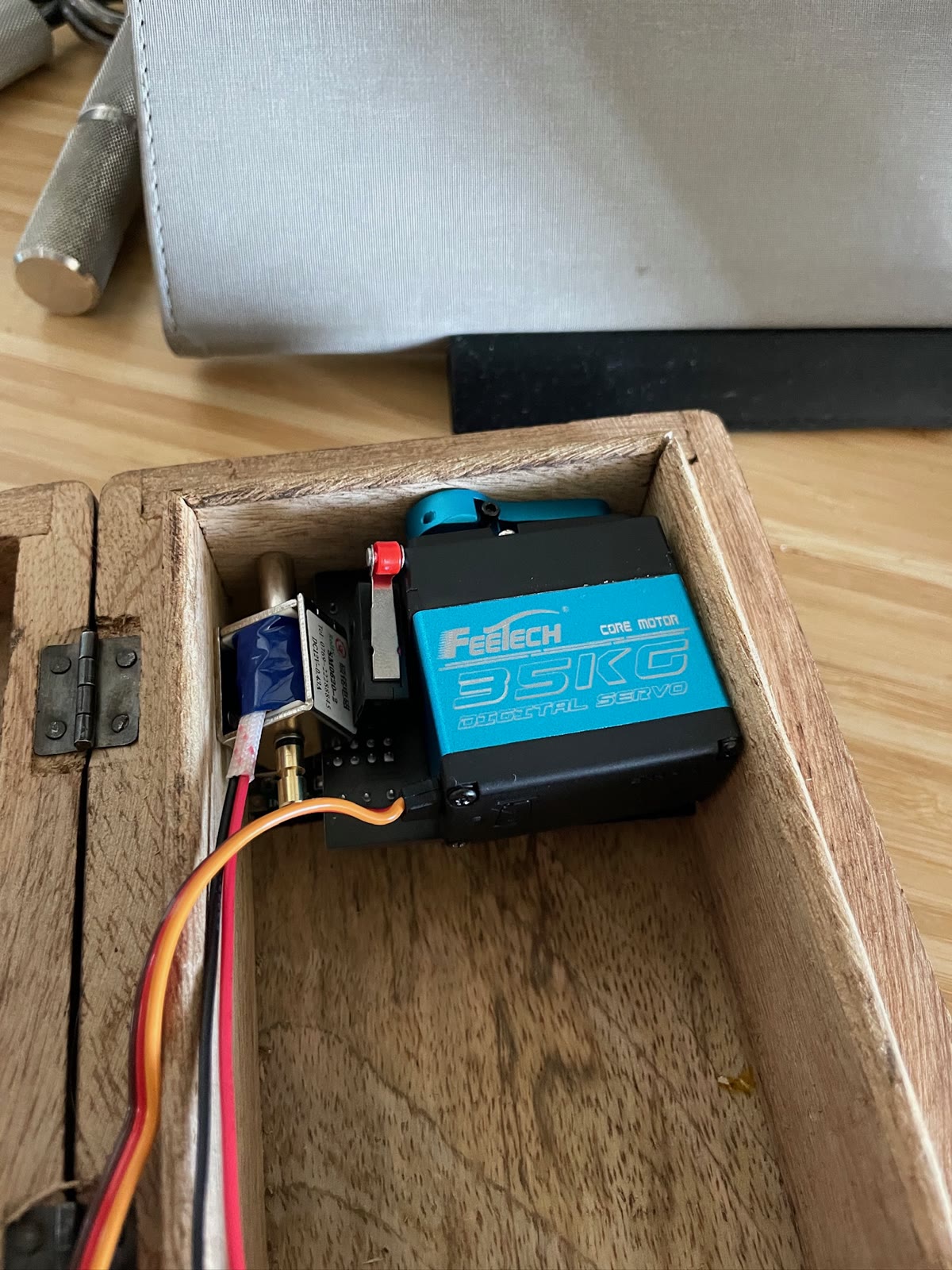
We decided to use a pre-made budget box from Amazon, with some hobbyist components like a servo, and a locking solenoid. You can see these in the image below which was a simple layout test for the device. We want to group these near the edge in one cluster so we can use the rest of the box for storage.
Electrical Design Vortex
Designing a circuit around these hobbyist components isn't all that challenging in 2025, the performance and behavior of the components is well known and Printed Circuit Board (PCB) creation has become easier than ever.
Needless to say we got a prototype up and running pretty quickly. We used an Arduino Nano dev board we had on hand for the PCB design. The device works simply: press the button and the box locks for a time we hard coded into firmware.
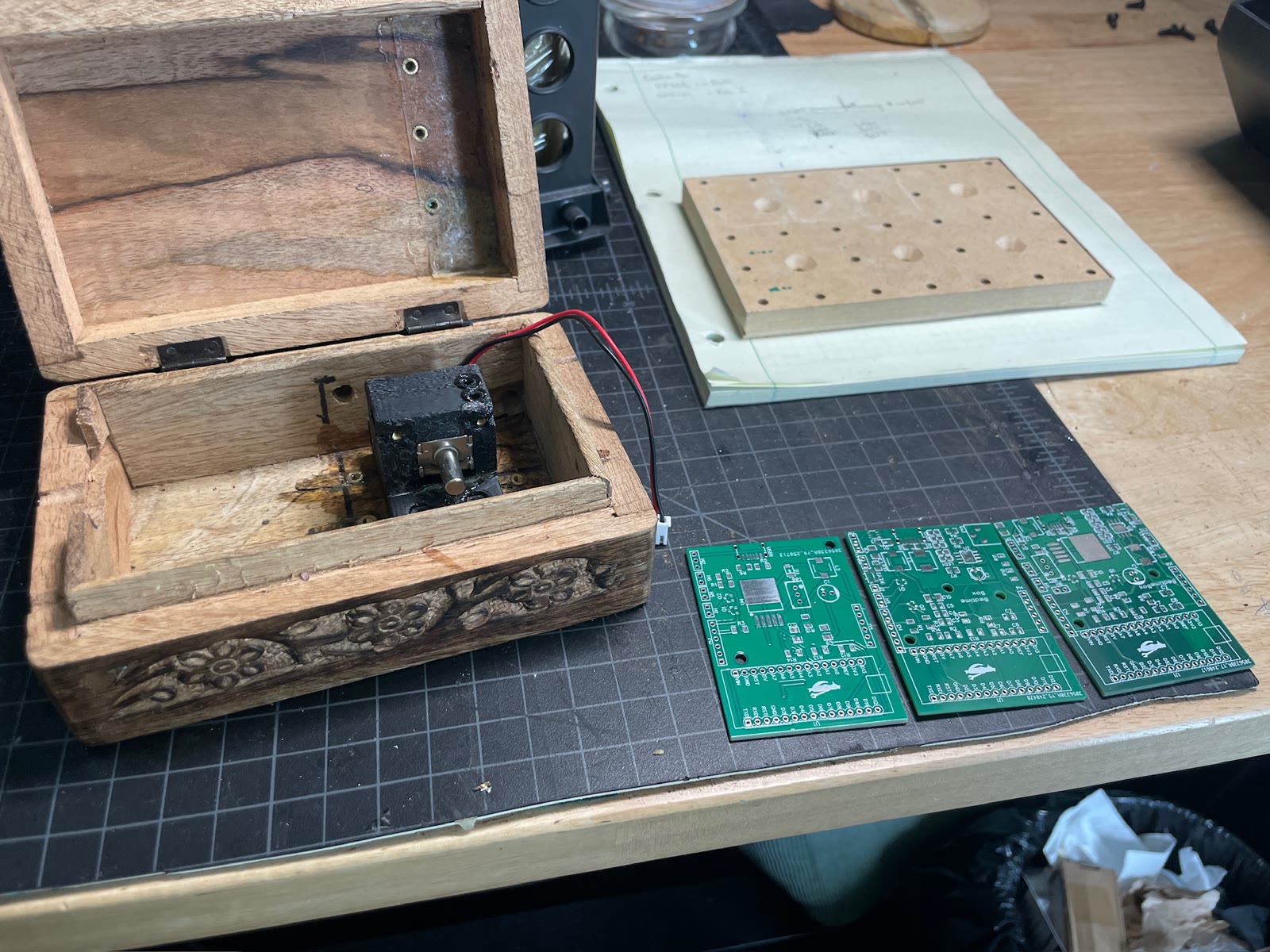
One potentially regrettable choice to solve the power off requirement for our demo was to include a battery backup. This ended up causing a bit of a headache with the peak solenoid current being too much for the chosen battery charging integrated circuit hardware. This caused a few extra PCB iterations but to be honest that's just how it goes with electrical engineering. Below you can see the three PCB boards that we created to get something that was rock solid.
Mechanisms & You
Because of the loose tolerances of the wooden box, we decided to "self-locate" all the functionality to the same assembly, instead of installing parts across parts of the box, this way the moving parts would interface correctly with relatively high accuracy.
The only real design decisions remaining were how to arrange the solenoid and servo, and ensure one cohesive block for the mechanism & electronics. Through a study of the various linkage options and forces involved, a rear mounted lever arm was chosen to move the lid, which would hold the lock. The solenoid was placed in line with the lock at the front of the box.
This ended up working as planned, however things were just getting interesting. Doing bench tests, things worked swimmingly. You can see this test below.
Integration Hell & Thinking Inside the Box
It's been our experience that getting to the finish line of any development design, the first 80% is fairly smooth but getting through that last 20% usually involves lots of swearing and uncomfortable segments of self doubt. This design was no exception.
In actually crossing the finish line and testing this device, we discovered the box wouldn't close all the way. Getting to the bottom of this problem, and troubleshooting the circuit and design would take us more hours than we care to admit. It's really hard to debug things when you can't see them.
Given prior issues with shorting we suspected an electrical power system issue that had already raised its head. We assumed that under load the electrical system would power off for a short time, causing a PCB reset. After some bench debugging we found that was false.
We manipulated the mechanism alignment out of the device to investigate how force would affect the mechanism. Nothing.
We got the box lid stuck to the lock many times, each having to remove the pins from the box hinges to "crack" into the device. A downside of the "don't break in requirement".
In the end it turned out the weak servo was having a hard time overcoming the friction in the poorly made Amazon box from China. Sometimes it's the hidden problems that can manifest & collide with our preconceived notions that cause the most problems. That sure is on par for the problem domain!
In the end we hit our mark in 8 weeks. It would be time to test & evaluate the idea behind the Detox Box.
An Encouraging Lesson
Beyond all of the fun lessons & debugging skills we picked up on the way, we were pleasantly surprised by our own reaction once we started regularly using the device.
While working from home, as the hour inches closer to quitting time, we normally have to resist the urge to take the edge off, especially if it's been a rough day.
The test regimes we ran differed based on what we were testing against. We found some common elements to the experience, and some marked differences depending on what we were locking away.
For the phone test we programmed the box for a 1hr lock time. This is to model a "deep-work" mode that you could remove your distractions so you can really focus for a certain amount of time. This worked exactly as planned, barring all of the other distractions at home, but we found "the reach" strongly subside almost immediately. After a day or so of use we habitually ignored the phone when it received a text, or when a "let me check my..." thought arrived. The Reach Was Defeated!
The real test would be locking up something we really liked, like our herbal substances. We initially tested locking the substance away for 22 hours. Basically allowing a two-hour window every day to enjoy the super secret "hobby", perfect for a pre-bedtime ritual.
In the same way we found "putting it down" to be easy, we found locking it away to be painless. Initially every impulse to smoke caused by reading a dumb client request or Slack message was met not with a mental "No Don't Do That" but more of a "You Can't Even If You Wanted To". That was the most surprising part. We had prepared ourselves to feel angst and loss at not being able to act on the impulse.
This was a subtle but powerful revelation, and it's backed up by science. It's triggering the fear of "loss" that causes most attempts at quitting to fail. "Never again" has an air of fatalism to it, but once a day or once a week is a lot more tolerable. Scheduling an open date / timer tricks the brain into avoiding that feeling of loss.
This particular build is well behind us now, but this is the exact moment the concept of "Pacing" dawned on us. It seems to be a much more attractive alternative to the abstinence that is normally preached as the only option in substance abuse treatment.