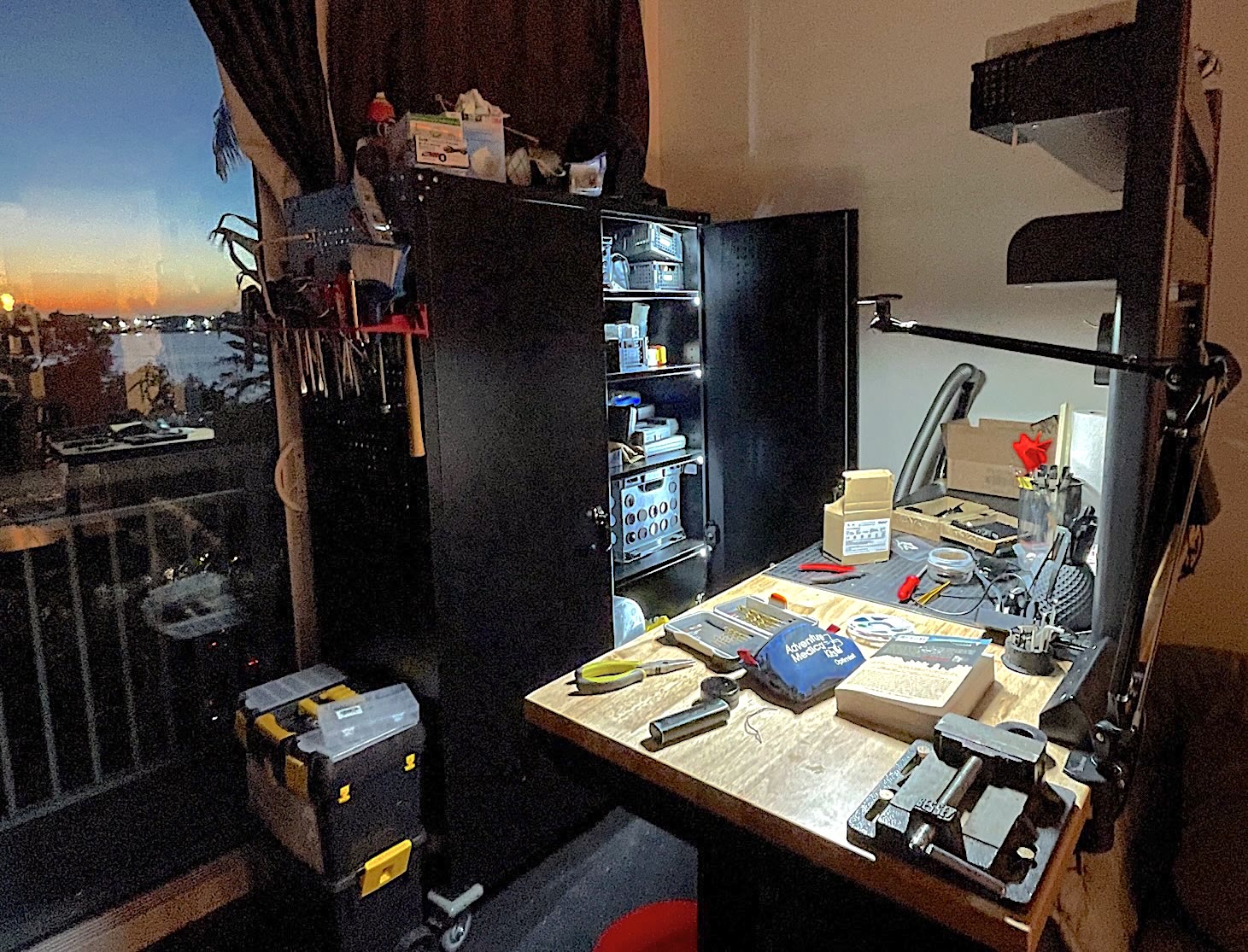
The first time I really lost the balance, I was building a smoke-capturing device for a couple of college kids — disciples of the Cheech-and-Chong lifestyle if I've ever met any. The device ignited your substance, caught your exhale, and filtered the smoke, capturing odors before emitting them back in the room. It was the perfect accessory for your freshman dorm room, or your parent's house. Engineers are curious animals; we can't build something without testing it. I tested it a lot. And somewhere in all that testing, I picked up a midday habit I hadn't planned on.
It felt earned, honestly. I was freelancing full-time for the first time after a decade in a very overly-serious industry. I was my own boss, my niche was expanding and a little afternoon smoke in my own workshop felt like a reasonable perk for a temporary risk. The project ended. The habit didn't. I clawed my way back eventually, but I remember how much work it took.
For a long while after that I had things right. Then COVID happened.
The lockdown pulled the floor out in a way that's hard to describe now. No structure, no clients walking in and out, no commute that marked the line between work and the rest of it. Just me and the screen and a climbing sense that the world had gone sideways. So I reached back for the thing that took the edge off. It became an evening wind-down. Then quietly, a little more than that.
I'd make the promise in the morning and break it by midnight. Not dramatically, just a half-step behind the person I wanted to be. I corrected course eventually, the way I always do. But every time I had to learn the same lessons all over again.
What finally clicked wasn't a breakthrough. It was more like noticing the obvious thing I'd been missing. It's something that a majority of people struggle with.
Willpower & Automatic Habits
It's now known that automatic habits bypass the "thinking circuit", the frontal lobe, and get their instructions straight from the basal ganglia aka the "lizard brain". It doesn't matter if they're good or bad habits. What drives people to take action, often without them ever thinking about it, is this primitive part of the brain.
Good habits like going to the gym, brushing your teeth before going to bed, and doing your homework all started somewhere and you built a system around them. Bad habits are more interesting, usually because they're an attempt for the mind to distract itself from the present environment or circumstances. The triggers for a drug addiction and a TikTok binge are wildly different, but they're the same in that the reach happens before you realize it.
Richard Branson, the legendary CEO and party animal, has built a system around managing potential substance abuse issues in his life. He will indulge for a few months at a time with alcohol and other light drug use, then go sober for a few months to wipe the slate clean.
Whatever pulls at you, willpower at 11pm is a weaker animal than willpower at 9am. You don't beat an automatic habit in the moment. You build distance and friction around the habit. Most of the time this means periods of abstinence because proximity is the enemy of distance. A little physical space between me and my habit, enough that the urge had to pass through something before it got to me. Without it, willpower will lose nine times out of ten.
That's not an original insight. The research has been pointing at it for years — friction and environment design work better than just trying harder. But insight doesn't help much unless it's real and it's there when you need it.
Pace & the Detox Box
So this is really the insight at the heart of this new venture of ours. We want to solve the problem of decoupling good intentions from willpower so that people can achieve their ideal life, or recover from a broken one.
This is embodied in our Detox Box. You put the thing you keep reaching for inside, your phone, a vape, whatever it is for you. Set the schedule when you're thinking clearly, and the box will back you up with its iron will. Opening, at the moment you set, not when your craving says so. It also functions as a safe storage box for these materials, which could potentially find their way into the hands of your children, pets or the authorities.
I built it because I needed it to be real for me, so I'm right there with you. The results keep encouraging me to work in this area and build something that works. This isn't another screen-time app I'd tap past in thirty seconds, or another broken promise, it's a physical commitment keeper.
I'm not here to sell you on quitting anything. Fun is legitimate. The edge is legitimate. What isn't sustainable is fighting yourself every night and waking up a half-step behind. The point isn't to stop having fun. It's to stop having fun on the terms that some part of yourself will be ashamed about.
The Detox Box is what that looks like built into hardware.
We're here to offer a new type of tool that allows everyone to live the lives they desire. It allows us to have a personal gatekeeper with an iron will that captures our best intention.