Over the last year we've learned a lot about ourselves and what is needed to successfully create a "temptation management device".
Our experience with the prototypes has shown that our Detox Box works for both brief temptations, and more pervasive stubborn ones. What remains is creating a polished version that is reasonably affordable, highly secure and manufacturable.
This post is a showcase of our design & build process, as well as the decisions we made along the way.
A Review of the Problem
Our previous post, Our Vision For The Detox Box, lays out the psychological model in full. The short version, because every design decision below follows from it:
- The reach is automatic. People with a habit they want to change already know they want to quit. The struggle isn't the decision, it's the reach that happens before the decision.
- Shame compounds it. Failing to resist triggers a shame spiral, which increases the compulsion and entrenches an identity as someone unworthy of a normal life.
- Public intervention carries a cost. Recovery groups genuinely help the people who attend, but the format is shame-inducing and society attaches a stigma to the association. It turns away all but the most desperate, so there is a gap in the treatment space.
- The permissible vices hide in plain sight. Workaholism, screens, food, and sex get carried with pride or shrugged off as normal, so they go unaddressed far longer.
- Quitting feels like loss. Giving up something that has been an enjoyable long term habit means giving up part of your past, and often friends, places, and routines along with it.
Identity, the automatic reach, and shame. Those three are what a solution has to work around.
Requirements for the Solve
The general advice for changing a habit is to build space around it, which usually means keeping the thing out of reach. Not because someone would use constantly, but because willpower only has to fail occasionally. That space is what buys time to work on whatever the vice was helping with, and that part is the individual's own work.
The Detox Box does exactly this: it locks the vice away according to your best intention, the same principle behind apps that limit screen time or block time-wasting sites, made physical.
Where we think pacing earns its keep is downstream. It is private and self-chosen, so there is no group, no declaration, and no stigma. And because you might still enjoy the habit once a week or once a month, whatever you decide is right, there is none of the grief or loss of identity that makes quitting so hard to sustain.
Design Considerations
We're not the first to consider a timed lock-box, the issues of self-control being widely studied and experienced. However, we are the first to consider making an intervention grade device to help those with the most stubborn habits. Lets look at what's out there and how we're making improvements on existing solutions.
Other solutions to controlling habits with a timed-lock box like the kSafe is that users report breaking into the device easily, or that it breaks of its own construction. Digital interventions, such as screen time blocking apps, can typically be voided by tapping a few settings or uninstalling an app. Beyond these approaches there aren't many solutions other than your own grit and willpower.
We will expand our requirements for the production version on top of the prototype requirements which were
- A robust container, large enough for a phone or vape, that resists break-in attempts.
- A robust locking mechanism that will remain locked through a duration until programmed to open
- The device should survive power-outages, and keep a running clock of when to open.
The promise we want to make to customers is: If you want to stop, that's all you need. You bring the intention — we bring the follow-through.
Iron Will in Walnut & Brass
It goes without saying that the Detox Box needs to be built like a vault and withstand serious attempts to break in. The core issue we're addressing is that our users will want whats inside the box, so much so that they might break it to get in. In the worst case scenario, individuals will need to get their fix so much they will break their cheap fragile timed-lockboxes to get in.
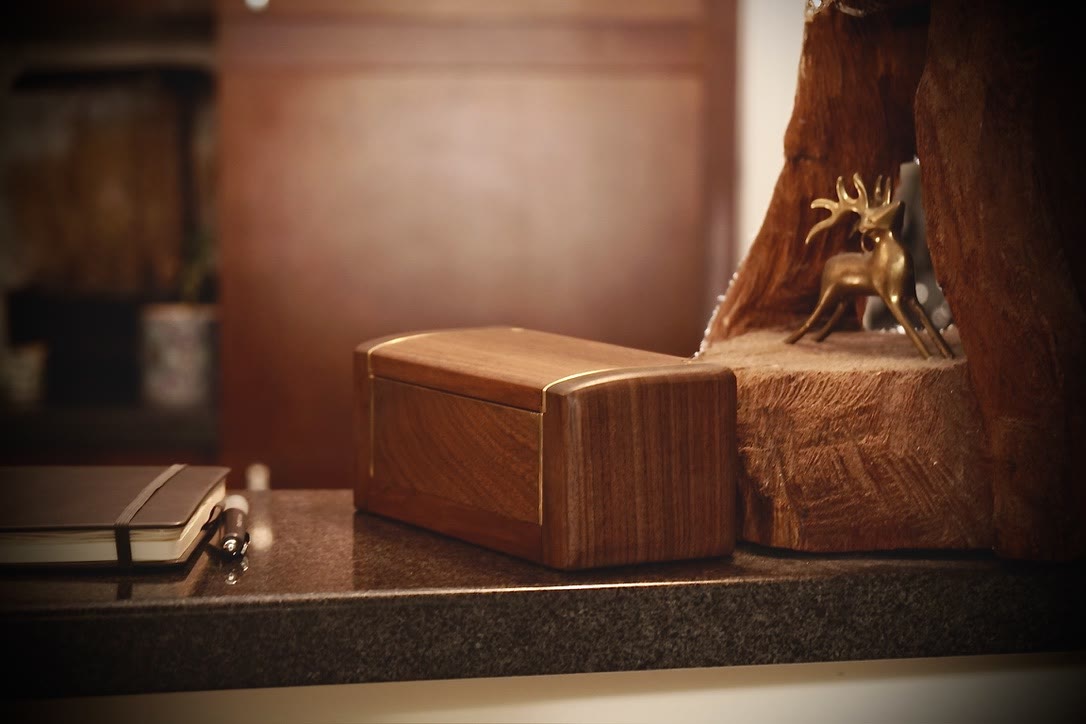
The second line of defense will be a beautiful craftsman design in rich walnut with brass fixtures. A fine heirloom device is much more likely to inspire devotion and use in a form factor that can be appreciated. It's certainly less likely to be broken into like a cheap plastic solution like the "ksafe". The Detox Box should look right at home on a bedside table, or could be mistaken for a jewelry box.
Finally the detox box must be highly reliable. Users are counting on it to keep their valuables, such as a phone or other vices. Functionality & Quality needs to match the appearance and security the box provides as well.
Our Vision Automated Accountability
Our existing "self-service" modes of daily, weekly, timer, and date modes work for anyone motivated to lock away their habit. What happens when that motivation slips?
The rest of the experience should leverage and follow existing guidelines on treatment of use disorders. We've already captured the most common, which is the building-space, adding-friction philosophy in getting away from your vices.
We're missing some key ingredients from treatment practices, and in our analysis this mostly centers on accountability. Your AA sponsor will have a serious talk with you when you relapse, we want to emulate this kind of accountability with the detox box.
While we're prioritizing our mechanical design & basic functionality first we're looking at the following features as candidates for an initial or subsequent release.
- An Accountability Partner Mode - Signals Your Sponsor If You Open The Box
- AI Guardian - A bot you have to convince to open the box based on your goals
- Family Mode - helps keep the families off screen
- Real Stakes - opening the box will donate money to a charity you hate (or love)
The only design implication for us here is that we need to have a microcontroller that is capable of handling audio, edge AI processing, and likewise has over-the-air (OTA) updates so these features can be rolled out as we improve our firmware / models.
Design Process
With our requirements and vision clear we can go about designing our first production candidate.
We can break our design process up into roughly three assemblies that we'll design in separate contexts.
- The locking & opening mechanism hardware
- The housing exterior & faces
- The electronics & firmware, which will be covered in a later post
Designing the Lock & Opening Mechanism
This assembly is arguably the most important aspect of the design, and due to our requirements of a beautiful looking enclosure we can't hack together off the shelf components to make our design work.
Our first requirement specifies a large internal space which implies that we need to have a low-profile mechanism, and it needs to be mostly hidden to keep our box beautiful. In hardware projects reliability and cost is always important so we need to keep this in mind as well.
We sketched and prototyped our way though numerous concepts. Each design and test reveals new practical realities that can't be shown in CAD. It was a very iterative process, but that's all part of the fun.
After testing & prototyping several versions we finally landed on a design we like, and it looks very cool as well. We're using a high gear ratio embedded in a common stepper motor to provide lots of torque. This motor turns a driver that will open the lid lever gear and when run the opposite direction it will force the lid closed, and finally secures a locking cam with the last tooth of the lever gear. This action can be shown below on the test bench.
We'll have two mechanisms on both left and right to increase redundancy and so this mechanism will simply be mirrored to create the opposite side version.
Designing the Housing
While the housing is conceptually simple, we don't work with wood a lot in consumer products so this was a new challenge. And it's an exciting one. There are few materials as beautiful to work with, however there are many nuances to getting it right such as grain direction, warp ect. This will be part of the fun.
Making intricate shapes with wood is possible, however what we're really interested in is something that is both strong, and manufacturable with conventional methods. We have a CNC machine (like 3D printing but removes material instead) in house so it's possible to manufacture these ourselves for a prototype. The video below will help showcase exactly how these parts are made.
The general approach here is to reduce the number of "setups" or the number of changes to the "stock" you have to make. For instance if you need to make holes on two sides of a part, you have to flip over the stock so you can access the part from each direction. Lots can go wrong with these setups, so we'll aim to reduce the number of required operations.
There's a huge number of joinery methods available considering how ancient the art of wood working is, so we'll need to pick the right one. We're interested in creating a high quality appearance so reducing the number of visible seams is paramount. Similarly we're interested in creating ultra-strong wood joinery. For both of these requirements the mortise and tenon joint, where a small sliver of one board inserts in another is the widely considered the standard for fine furniture for its strength and hidden seams.
Other than these joints we need to create pockets for the other components and parts to fit in. Namely the left and right mechanisms, the stepper motors, as well as the electronics and the USB port. The complex pockets and dual sided machining was isolated to the base and end caps. The end caps and mechanisms will be manufactured as subassemblies, tested individually then all components will be fit together and tested again.
The way the lid is constructed, with brass fixtures attached through wood screws and captive nuts will also provide mechanical stiffness pulling the endcaps together through the brass retainer plate on each end. Two large spring-loaded 10mm hinges will deploy as the final step when attaching the lid to the rest of the assembly.
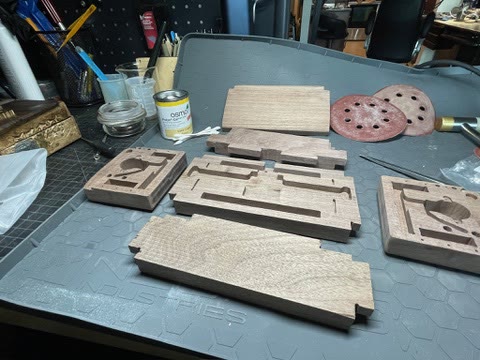
We've decided to finish the hardwood with a hardwax oil for its clean finish that lets the wood grain pop. This also provides a durable finish that is easy to reapply. This might change later, but for now it looks great.
All Together Now
The beauty of working with precise processes like CNC machining is that parts fit together extremely well. We got great results on the fit of the wood mortise and tenon joints, as well as the precision of the brass parts.
As such assembling was a cakewalk, however we've built such a strong mechanism and interlinking of parts it's impossible to disassemble after the lid hinges deploy and if the parts are glued together. Here it is all ready for testing and awaiting our assembled electronics parts which should be the next installment of our development journal.
While you're waiting for our kickstarter to launch, take our pacing quiz to find out what your pacing profile is.